现代工业流量开关选型指南:从热力学原理到高密度热管理
引言:流体动力学的“告密者”
In my 15 years navigating the industrial automation and fluid control sectors, I have reviewed countless post-mortem failure analyses. The most painful lesson is always the same: the failure of an inconspicuous, sub-tier component can cause a catastrophic shutdown of a multimillion-dollar asset.
在我从事工业自动化和流体控制行业的15年中,我审阅过无数次故障后分析报告。最惨痛的教训总是相同的:一个不起眼的次级组件的故障,就可能导致价值数百万美元的资产彻底停产。
If precision sensors represent the nervous system of an industrial complex, the flow switch is its vital "whistleblower." Hidden deep within complex piping networks, this component monitors the velocity of cooling loops and process fluid lifelines. It sounds the alarm at the exact millisecond a flow rate drops below critical thresholds, stopping terminal thermal overruns before they can begin.
如果说精密传感器是工业系统的神经系统,那么流量开关就是其至关重要的“告密者”。这个组件深藏于复杂的管道网络之中,负责监测冷却回路和工艺流体生命线的流速。一旦流速降至临界阈值以下,它便会在毫秒级的瞬间发出警报,从而在最终热过载发生之前将其阻止。
As modern industry transitions toward ultra-high-power densities—typified by tens-of-megawatts AI computing clusters and high-pressure hydrogen ecosystems—legacy fluid monitoring methods are hitting their physical limits. This guide deconstructs the core physics of modern flow switches, decodes their critical technical datasheets, and provides a framework for integrating these vital components into next-generation industrial architectures.
随着现代工业向超高功率密度转型——以数十兆瓦的人工智能计算集群和高压氢气生态系统为代表——传统的流体监测方法正面临物理极限。本指南深入剖析了现代流量开关的核心物理原理,解读了其关键技术数据,并提供了一个将这些重要组件集成到下一代工业架构中的框架。
1. Deconstructing Thermodynamic Sensor Physics: The Death of Mechanical Moving Parts
1. 解构热力学传感器物理学:机械运动部件的消亡
For decades, industrial piping relied heavily on mechanical flow switches (such as paddle, target, or magnetic baffle designs). Their operational logic is simple: the kinetic force of a moving fluid physically displaces a spring-loaded paddle, which mechanically triggers a microswitch.
几十年来,工业管道系统主要依赖机械式流量开关 (例如桨式、靶式或磁性挡板式)。它们的运行原理很简单:流动流体的动能使弹簧加载的桨叶发生位移,从而机械地触发微动开关。
[Legacy Mechanical Switch] -> Fluid Push -> Physical Displacement -> Mechanical Wear -> Jamming Risk [Modern Thermal Dispersion] -> Fluid Flow -> Thermal Dissipation -> Solid-State Analysis -> Zero Wear
However, this intrusive, contact-based approach harbors severe vulnerabilities in high-uptime, modern industrial configurations:
然而,这种侵入式、基于接触的方法在高正常运行时间的现代工业配置中存在严重的漏洞:
Mechanical Fatigue: Continuous cycling causes spring relaxation and pivot wear, leading to drift in the set-point calibration.
机械疲劳: 持续循环会导致弹簧松弛和枢轴磨损,从而导致设定点校准漂移。Particulate Binding: Any particulate matter, scale, or biological fouling present in the fluid can easily lodge in the mechanical hinges, causing the switch to jam in either a false-positive or false-negative state.
颗粒物粘附: 流体中存在的任何颗粒物、水垢或生物污垢都容易卡在机械铰链中,导致开关卡在假阳性或假阴性状态。Pressure Drop ($\Delta P$): Large mechanical paddles introduce localized flow restrictions, causing parasitic pressure drops across the line.
压降( $\Delta P$ ): 大型机械桨叶会造成局部流动限制,从而导致管路中出现寄生压降。
To eliminate these vulnerabilities, thermal dispersion (thermal mass) flow switches have become the industry standard for high-reliability applications.
为了消除这些漏洞, 热扩散(热质量)流量开关已成为高可靠性应用领域的行业标准。
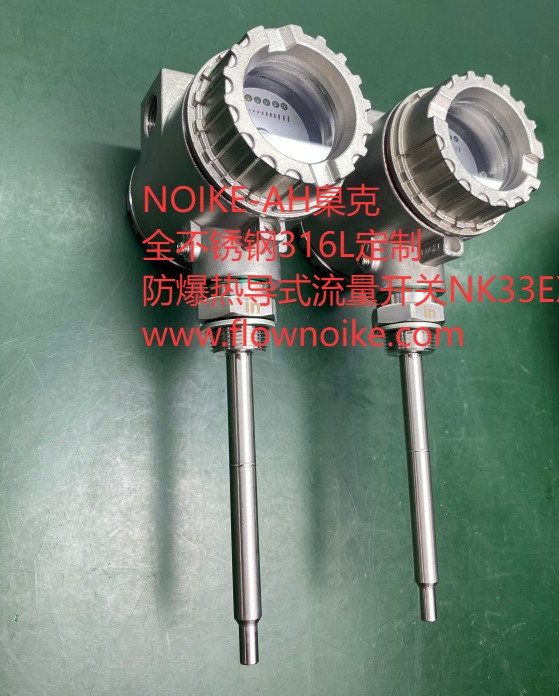
The foundational advantage of a thermal dispersion flow switch is its solid-state, zero-moving-parts architecture. The immersion probe contains two high-precision Resistance Temperature Detectors (typically PT100 or PT1000 platinum RTDs) housed within a rugged metallic tip:
热扩散流量开关的基本优势在于其固态、零移动部件的结构 。浸入式探头包含两个高精度电阻温度检测器(通常为 PT100 或 PT1000 铂电阻温度检测器),它们封装在坚固的金属尖端内:
The Reference RTD: This sensor remains unheated and continuously measures the true, ambient temperature of the process fluid ($T_{amb}$).
参考 RTD: 该传感器保持未加热状态,持续测量过程流体的真实环境温度 (T)。 安培 ).The Heated RTD: This sensor is continuously supplied with a regulated electrical current, maintaining its temperature at a constant, elevated level above the fluid ($T_{hot}$).
加热式热电阻: 该传感器持续通入恒定电流,使其温度保持在高于流体温度的恒定较高水平 (T)。 热的 ).
When the fluid is completely stagnant, a maximum and constant temperature differential ($\Delta T = T_{hot} - T_{amb}$) is established between the two RTDs. As the fluid begins to move past the probe tip, it absorbs and carries away thermal energy from the heated RTD via convective heat transfer. The rate of this thermal dissipation is directly proportional to the mass flow velocity of the fluid.
当流体完全静止时,温差最大且恒定(ΔT=T)。 热的 −T 安培 在两个热电阻之间建立连接。当流体开始流过探针尖端时,它会通过对流换热吸收并带走来自加热热电阻的热能。这种热耗散速率与流体的质量流速成正比。
The faster the fluid moves, the more rapidly the heated RTD cools down, causing the temperature differential ($\Delta T$) to shrink. An embedded microprocessor continuously monitors this thermal change, compares it against a pre-calibrated curve, and switches an output relay (e.g., PNP/NPN or dry contact) the moment the velocity crosses the engineered threshold.
流体流动速度越快,加热的 RTD 冷却速度也越快,导致温差(0)减小。嵌入式微处理器持续监测这种温度变化,并将其与预先校准的曲线进行比较,一旦流速超过预设阈值,就立即切换输出继电器(例如 PNP/NPN 继电器或干接点)。
Because this method relies entirely on thermodynamic heat transfer rather than physical kinetic force, it eliminates mechanical wear, resists fouling, and delivers a maintenance-free lifecycle spanning millions of operating hours.
由于该方法完全依赖于热力学传热而不是物理动能,因此可以消除机械磨损,防止结垢,并实现数百万小时的免维护使用寿命。
2. Deciphering the Technical Datasheet: How to Avoid Parameter Traps
2. 解读技术数据表:如何避免参数陷阱
B2B technical buyers frequently make the mistake of evaluating flow switches purely on pipe size and cost. To ensure long-term system stability, an engineer must accurately decode four core technical performance vectors:
B2B 技术采购人员经常犯的一个错误是,他们仅仅根据管道尺寸和成本来评估流量开关。为了确保系统的长期稳定性,工程师必须准确解读以下四个核心技术性能指标:
A. Flow Velocity Sensitivity Range
A. 流速敏感范围
Mainstream Standards: Water/Liquids: $1 \sim 150 \text{ cm/s}$; Gases: $20 \sim 2000 \text{ cm/s}$.
主流标准: 水/液体: $1 \sim 150 \text{ cm/s}$ ;气体: $20 \sim 2000 \text{ cm/s}$ 。Engineering Insights: It is critical to recognize that thermal dispersion sensors measure velocity at the probe tip, not volumetric flow rate. The defining strength of this technology is its exceptional sensitivity to low-flow thresholds. In micro-channel cooling networks, volumetric flow rates may be exceptionally small, resulting in velocities that cannot actuate a mechanical target. A high-performance thermal switch can reliably detect a velocity drop down to a creeping 1 cm/s, providing an early warning long before absolute stagnation occurs.
工程洞察: 必须认识到,热扩散传感器测量的是探针尖端的速度 ,而非体积流量 。这项技术的核心优势在于其对低流量阈值的极高灵敏度 。在微通道冷却网络中,体积流量可能非常小,导致速度低到无法驱动机械目标。高性能热开关能够可靠地检测到低至 1 cm/s 的速度下降,从而在绝对停滞发生之前发出预警。
B. Response Damping & Algorithmic Delay
B. 响应阻尼与算法延迟
Mainstream Standards: Typical response time of $2 \sim 8 \text{ seconds}$; integrated programmable damping software delays up to $60 \text{ seconds}$.
主流标准: 典型响应时间为 $2 \sim 8 \text{ seconds}$ ;集成可编程阻尼软件延迟高达 $60 \text{ seconds}$ 。Engineering Insights: Engineers accustomed to the instantaneous mechanical snap of a spring-loaded paddle often view the multi-second response of a thermal sensor as a drawback. In field operations, however, this slight thermal inertia acts as an excellent low-pass filter against transient noise.
Industrial fluid lines frequently encounter brief entrained air pockets, localized vapor flashing, or rapid pressure spikes caused by pump handovers. A mechanical switch reacts instantly to these anomalies, causing false alarms and unnecessary system trips. A thermal switch allows engineers to configure a smart damping delay (e.g., 3 seconds), effectively masking these harmless transient events and avoiding costly false shutdowns.
工程洞察: 习惯了弹簧桨叶瞬间机械响应的工程师通常会将热传感器数秒的响应时间视为缺点。然而,在现场作业中,这种轻微的热惯性却能起到极佳的低通滤波器作用,有效抑制瞬态噪声 。 工业流体管路经常会遇到短暂的夹带气穴、局部蒸汽闪蒸或泵切换引起的压力骤升。机械开关会对这些异常情况立即做出反应,导致误报和不必要的系统跳闸。而热敏开关则允许工程师配置智能阻尼延迟(例如 3 秒),有效掩盖这些无害的瞬态事件,避免代价高昂的误停机。
C. Metallurgical Metallurgy & Pressure Integrity
C. 冶金冶金与压力完整性
Mainstream Standards: Nominal operating pressures from $25 \sim 100 \text{ bar}$ (with high-pressure variants rated up to $200 \text{ bar}$); Standard construction: SUS 316L / EN 1.4404 Stainless Steel.
主流标准: 额定工作压力从 $25 \sim 100 \text{ bar}$ (高压型号额定压力高达 $200 \text{ bar}$ );标准结构: SUS 316L / EN 1.4404 不锈钢 。Engineering Insights: Because the immersion probe is machined from a single, continuous piece of bar stock, there are no structural joints, internal dynamic O-rings, or thin diaphragms to fail under stress. This monolithic construction turns the sensor probe into an high-strength pressure barrier capable of operating in aggressive chemical fluids and high-stress environments without risking external leaks.
工程洞察: 由于浸入式探头由一整块连续棒材加工而成,因此不存在结构连接点、内部动态 O 型圈或薄隔膜等易受应力影响的部件。这种整体式结构使传感器探头成为高强度压力屏障,能够在腐蚀性化学流体和高应力环境下稳定运行,而不会发生外部泄漏。
3. High-Tech Applications: Flow Switches on the Industrial Frontlines
3. 高科技应用:工业前沿的流量开关
To appreciate the engineering value of solid-state flow monitoring, we must look at how these principles protect infrastructure in three rapidly growing technical sectors.
要了解固态流动监测的工程价值,我们必须看看这些原理是如何保护三个快速增长的技术领域的基础设施的。
Application 1: AI Data Centers & Supercomputing Coolant Distribution Units (CDUs)
应用 1:人工智能数据中心和超级计算冷却剂分配单元 (CDU)
The explosion of high-density AI accelerators and multi-chip modules (MCMs) has pushed rack power densities beyond $100\text{ kW}$, completely exceeding the capabilities of traditional air-cooling infrastructure. Modern hyperscale data centers use Coolant Distribution Units (CDUs) that circulate either high-purity water chemistries (such as deionized water blends) or specialized engineered fluids (such as dielectric fluorinated liquids) through micro-channel cold plates directly attached to the silicon.
高密度人工智能加速器和多芯片模块 (MCM) 的爆炸式增长,已将机架功率密度推至远超 0,彻底超越了传统风冷基础设施的承载能力。现代超大规模数据中心采用冷却剂分配单元 (CDU),通过直接连接到硅芯片的微通道冷板,循环高纯度水(例如去离子水混合物)或专用工程流体(例如介电氟化液体)。
The Critical Pain Point: The thermal mass of a high-performance GPU running at peak compute loads is extremely small relative to its heat output. If a localized fluid interruption occurs, the silicon temperature can spike past safe operating thresholds within seconds, causing immediate thermal throttling, permanent structural damage, or localized delamination of the semiconductor packaging.
关键痛点: 高性能 GPU 在峰值计算负载下运行时,其热容量相对于其发热量而言非常小。如果局部流体中断,硅片温度会在几秒钟内飙升至安全工作阈值以上,导致立即发生热节流、永久性结构损坏或半导体封装局部分层。The Thermal Switch Solution: Solid-state thermal switches are integrated directly into the liquid cooling manifolds and individual server blade inlets. Because they introduce near-zero pressure drop ($\Delta P$), they do not degrade the overall hydraulic efficiency of the pump loops. Beyond detecting total flow loss, their high sensitivity allows them to detect slight, progressive velocity drops. This characteristic allows them to serve as an early-warning diagnostic tool for localized particulate clogging within the micro-channels or for minor, hidden fluid leaks before they cause an electrical short.
热开关解决方案: 固态热开关直接集成到液冷歧管和各个服务器刀片进水口中。由于它们几乎不引入压降 ( $\Delta P$ ),因此不会降低泵回路的整体水力效率。除了检测总流量损失外,它们的高灵敏度还能检测到细微的、渐进式的速度下降。这一特性使它们能够作为早期预警诊断工具 ,用于检测微通道内的局部颗粒堵塞或轻微的、隐蔽的流体泄漏,从而避免造成短路。
Application 2: Battery Energy Storage Systems (BESS) & EV Thermal Management
应用 2:电池储能系统(BESS)及电动汽车热管理
Grid-scale Lithium-ion Battery Energy Storage Systems (BESS) packaged in modular outdoor enclosures require tight thermal management to maintain cell equilibrium and prevent catastrophic failures.
采用模块化户外外壳封装的电网级锂离子电池储能系统 (BESS) 需要严格的热管理,以维持电池平衡并防止灾难性故障。
The Critical Pain Point: During high-rate charging or discharging cycles, battery cells generate substantial internal heat. If a liquid-cooling branch pump fails or a cold-plate header suffers an internal flow imbalance, localized hotspots develop rapidly. This localized thermal stress is the primary trigger for thermal runaway, which can initiate a self-sustaining chain-reaction fire that destroys the entire enclosure.
关键痛点: 在高倍率充放电循环过程中,电池单体会产生大量的内部热量。如果液冷支泵发生故障或冷板集管内部流量失衡,就会迅速形成局部热点。这种局部热应力是引发热失控的主要诱因,而热失控可能引发持续的连锁反应火灾,最终烧毁整个外壳。The Thermal Switch Solution: Installing zero-moving-parts thermal flow switches directly into the battery pack manifolds ensures continuous flow verification. Unlike mechanical switches, which can experience false trips from the constant mechanical vibrations of surrounding pumps or transport movement, the solid-state thermal sensor remains completely unaffected by physical shock, providing highly reliable monitoring throughout the service life of the energy storage asset.
热开关解决方案: 将无运动部件的热式流量开关直接安装到电池组歧管中,可确保持续的流量验证。与机械开关不同,机械开关可能会因周围泵的持续机械振动或输送运动而产生误动作,而固态热传感器完全不受物理冲击的影响,可在储能设备的整个使用寿命期间提供高度可靠的监测。
Application 3: Hydrogen Production, Storage, and Fuel Cell Systems
应用3:氢气生产、储存和燃料电池系统
The emerging hydrogen economy requires fluid handling under extreme physical conditions, including high pressures, cryogenic temperatures, and highly volatile gas mixtures.
新兴的氢能经济需要在极端物理条件下进行流体处理,包括高压、低温和高度挥发性气体混合物。
The Critical Pain Point: In high-capacity hydrogen refueling stations (operating at nominal pressures up to 700 bar) or heavy-duty PEM electrolyzer stacks, process components are exposed to high pressure differentials and the threat of hydrogen permeation. Standard alloys suffer severely from hydrogen embrittlement, which causes microscopic cracking, catastrophic structural failures, and highly dangerous high-pressure gas leaks.
关键痛点: 在高容量加氢站(额定工作压力高达 700 巴 )或重型 PEM 电解槽堆中,工艺部件暴露于高压差和氢气渗透的威胁之下。标准合金极易发生氢脆 ,导致微观裂纹、灾难性结构失效以及极其危险的高压气体泄漏。The Thermal Switch Solution: In these setups, flow switches must be manufactured from specialized, high-grade SUS 316L Stainless Steel with optimized nickel and chromium content to resist hydrogen embrittlement. Whether deployed in the ultra-high-pressure gas lines to verify hydrogen distribution or in the low-temperature auxiliary cooling loops to manage process temperatures, these switches provide the necessary ruggedness to prevent leaks and structural failures.
热敏开关解决方案: 在这些装置中,流量开关必须采用特殊的优质 SUS 316L 不锈钢制造,并优化镍铬含量,以防止氢脆。无论部署在超高压气体管路中以验证氢气分布,还是部署在低温辅助冷却回路中以控制工艺温度,这些开关都具有必要的坚固性,可防止泄漏和结构故障。
4. Implementation Methodology: Field Rules for Project Engineers
4.实施方法:项目工程师现场规则
To ensure successful field deployment of a flow switch in a critical engineering design, adhere strictly to these three deployment rules:
为确保在关键工程设计中成功部署流量开关,请严格遵守以下三条部署规则:
Rule 1: Master the Boundary Layer Geometry (The "5D + 3D" Rule)
规则 1:掌握边界层几何(“5D + 3D”规则)
Thermal dispersion flow switches calculate volumetric flow velocity by measuring heat transfer at a specific point within the pipe's velocity profile. Any upstream hydraulic disturbance—such as a partially closed ball valve, an abrupt $90^\circ$ elbow, or a concentric reducer—creates turbulent eddies and velocity profile distortion.
热扩散式流量开关通过测量管道速度剖面中特定点的热传递来计算体积流速。任何上游水力扰动——例如部分关闭的球阀、突变弯头或同心异径管——都会产生湍流涡旋和速度剖面畸变。
Field Protocol: Always install the flow switch probe with a minimum of 5 pipe diameters (5D) of straight, unobstructed pipe upstream, and a minimum of 3 pipe diameters (3D) downstream. This configuration allows the fluid to re-establish a stable, laminar boundary layer before it contacts the sensor tip, ensuring precise and predictable switching thresholds.
现场操作规程: 始终确保流量开关探头上游至少有 5 倍管径 (5D) 的直管段 , 下游至少有 3 倍管径 (3D) 的直管段。这种配置可使流体在接触传感器尖端之前重新建立稳定的层流边界层,从而确保精确且可预测的切换阈值。 Upstream Disturbance (Valve/Elbow) │ ▼ ┌───────────────────────┐ ┌────────────────────────┐ │ │ Probe │ │ ───────┘ └─────▼───────┘ └─────── Flow ──> Turbulent Eddies Laminar Flow Stable Recovery ──> ───────┐ ┌─────────────┐ ┌─────── │ │ │ │ └───────────────────────┘ └────────────────────────┘ |<───── Minimum 5D ────>| |<───── Minimum 3D ─────>|
Rule 2: Account for the Realities of Multi-Phase Flow (Gas Entrainment)
规则 2:考虑多相流的实际情况(气体夹带)
If a liquid cooling system is prone to continuous air entrainment due to poor reservoir de-aeration or minor vacuum leaks on a pump suction line, the sensor will encounter gas bubbles. When an entrained air pocket passes over the heated RTD, the thermal dissipation rate drops instantly compared to the liquid phase. This transient drop can mimic a low-flow condition, leading to a false alarm.
如果液冷系统由于储液罐排气不畅或泵吸气管路存在轻微真空泄漏而容易持续混入空气,传感器就会遇到气泡。当混入的气泡流过加热的 RTD 时,其散热速率会瞬间低于液相。这种瞬时下降会模拟低流量状态,从而导致误报。
Field Protocol: Ensure the loop includes a mechanical air separator upstream. Position the flow switch probe horizontally or at a slight upward angle ($45^\circ$) relative to the pipe axis. Avoid top-vertical mounting where buoyant air pockets naturally collect, and avoid bottom-vertical mounting where heavy particulates settle. Additionally, tune the device's internal software damping delay to smoothly ride through transient air pockets.
现场操作规程: 确保回路上游包含机械式空气分离器。将流量开关探头水平放置或相对于管道轴线略微向上倾斜( $45^\circ$ )。避免顶部垂直安装(此处易积聚浮力气穴),也避免底部垂直安装(此处易沉积重颗粒物)。此外,调整设备的内部软件阻尼延迟,使其能够平稳地通过瞬态气穴。
Rule 3: Enforce Material Traceability and Verify Fluid Calibration
规则3:强制执行材料可追溯性并验证流体校准
In high-stakes industrial projects—such as chemical processing units or international B2B equipment exports—an unverified or uncalibrated instrument introduces significant liability. The financial impact of an unscheduled shutdown or an environmental leak easily dwarfs the initial cost of the sensor.
在高风险的工业项目中——例如化工装置或国际 B2B 设备出口——未经验证或校准的仪器会带来巨大的责任风险。计划外停机或环境泄漏造成的经济损失很容易超过传感器的初始成本。
Field Protocol: Specify instrumentation from manufacturers that provide complete material traceability reports (such as EN 10204 3.1 certification) to guarantee true SUS 316L metallurgy. Furthermore, ensure the manufacturer performs factory calibration tailored to the specific operational fluid. Highly viscous dielectric fluids, glycol-water formulations, and hydrocarbons exhibit vastly different thermal conductivities ($\mathbf{k}$) than pure water. Utilizing a flow switch with factory-calibrated curves designed specifically for your target process medium is the only way to ensure the long-term accuracy and safety of your system.
现场操作规程: 指定使用能够提供完整材料可追溯性报告(例如 EN 10204 3.1 认证)的制造商生产的仪器,以确保 SUS 316L 不锈钢的真实冶金性能。此外,还要确保制造商针对特定操作流体进行出厂校准。高粘度介电流体、乙二醇-水混合物和碳氢化合物的热导率 ( $\mathbf{k}$ ) 与纯水相比差异巨大。使用专为目标工艺介质设计的、带有出厂校准曲线的流量开关,是确保系统长期精度和安全性的唯一途径。
Technical Comparison Matrix
技术对比矩阵
To assist procurement and design teams in their technology evaluations, the table below highlights the operational differences between legacy and modern flow monitoring technologies:
为了帮助采购和设计团队进行技术评估,下表重点列出了传统流量监测技术与现代流量监测技术在操作上的差异:
| Operational Attribute 操作属性操作属性 操作属性 | Legacy Mechanical Switches (Paddle / Target Type)传统机械开关(拨片式/靶心式) | Modern Thermal Dispersion Switches (Solid-State)现代热扩散开关(固态)现代热扩散开关(固态)现代热扩散开关(SSD) |
| Moving Parts 活动部件 | Yes (Subject to mechanical wear and fatigue) 是的(受机械磨损和疲劳影响) | None (Zero physical wear, solid-state) 无(零物理磨损,固态) |
| Minimum Reliable Velocity 最低可靠速度 | $\approx 20 \sim 30 \text{ cm/s}$ (Insensitive to micro-flows) $\approx 20 \sim 30 \text{ cm/s}$ (对微流不敏感) | $1 \text{ cm/s}$ (Exceptional low-flow detection) $1 \text{ cm/s}$ (卓越的低流量检测) |
| Pressure Drop ($\Delta P$) 压降( $\Delta P$ ) | Moderate to High (Displacement blade restricts flow) 中度至高度(置换叶片限制了流量) | Negligible (Low-profile immersion probe) 可忽略不计 (低剖面浸入式探头) |
| Fouling & Particulate Risk 污垢和颗粒物风险 | High (Susceptible to mechanical jamming) 高(易受机械卡滞影响) | Low (Smooth, non-moving probe resists scale) 低 (光滑、静止的探针难以吸附刻度) |
| Signal Conditioning 信号调理 | Raw microswitch (Prone to contact bounce) 原始微动开关(易发生触点抖动) | Integrated microprocessor with adjustable delays 集成微处理器,具有可调延迟 |
| Primary Failure Mode 主要故障模式 | Mechanical binding, spring fatigue, or seal leak 机械卡滞、弹簧疲劳或密封泄漏 | Electronic component end-of-life 电子元件报废 |
Conclusion 结论
The demanding reliability requirements of modern industrial processes are rapidly making legacy, mechanical components obsolete. The transition from physical mechanical paddles to solid-state thermodynamic sensing represents a major evolution in underlying safety philosophy. By selecting a high-performance thermal dispersion flow switch, engineers can build a highly resilient, long-term line of defense for critical fluid and thermal management networks.
现代工业流程对可靠性的严苛要求正迅速淘汰传统的机械部件。从物理机械桨叶到固态热力学传感的转变,标志着安全理念的重大革新。通过选择高性能的热扩散流量开关,工程师可以为关键的流体和热管理网络构建一道高可靠性、长期稳定的安全防线。
此内容仅供参考,具体请联系镍克工程师傅详询详情.